
A Colorist of 25 Years Told Her Longest Client to Stop Paying Her for Roots, Then Opened a Drawer
Why your part starts to glow about ten days after the salon, and the small weekly routine I now send my gray clients home with.
If you have ever moved your part to the other side on a Thursday so nobody would see what was coming in...
If you have ever stepped out of a family photo, or offered to be the one holding the camera...
If you count the days to your next appointment the way a kid counts to Christmas, only without the fun...
Then I owe you an explanation. Because I am the woman who books that appointment, and for a long time I did not tell my clients the whole truth.
My name is Teresa. I am forty-nine, I have colored hair for twenty-five years, and I own a small two-chair salon in Omaha, Nebraska.
What follows will probably make you a little angry. Not at yourself. At the calendar you have been living by.
I Make Most of My Money on Roots
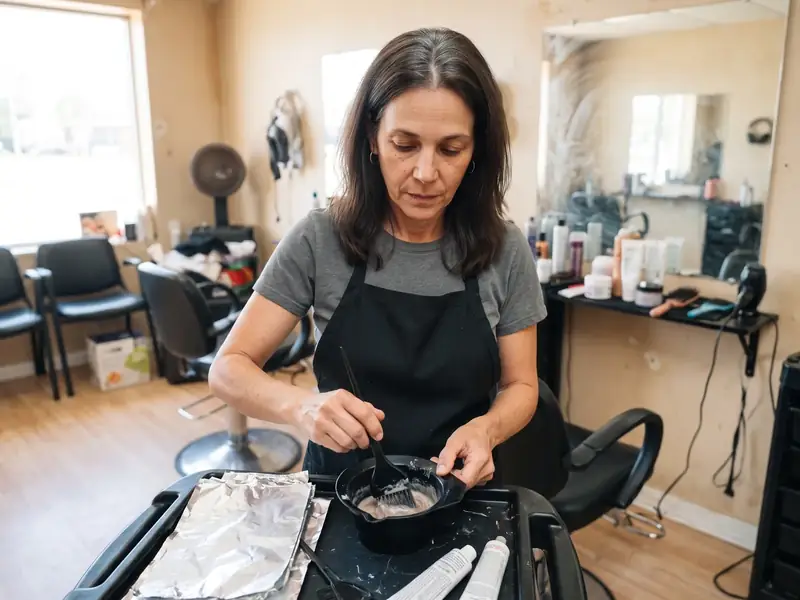
Here is the confession, plainly: gray roots pay my rent. Cuts are nice. Highlights are fun. But the steady money in a salon like mine is the root touch-up.
A woman finds her first real patch of gray somewhere around forty-five. From then on, she is in my chair every four to six weeks, which is how most colorists book gray coverage.
Across the country, a root color with a blow-dry runs anywhere from $60 to $250 depending on the city and the salon. That is a public number. Ask anyone.
I never thought of that as a problem. I was good at it. My clients left happy. They hugged me at the door.
What I did not say out loud is what happens two weeks later, when they are home, in front of their own bathroom mirror, and I am not there.
Then Barbara Walked In Wearing a Scarf
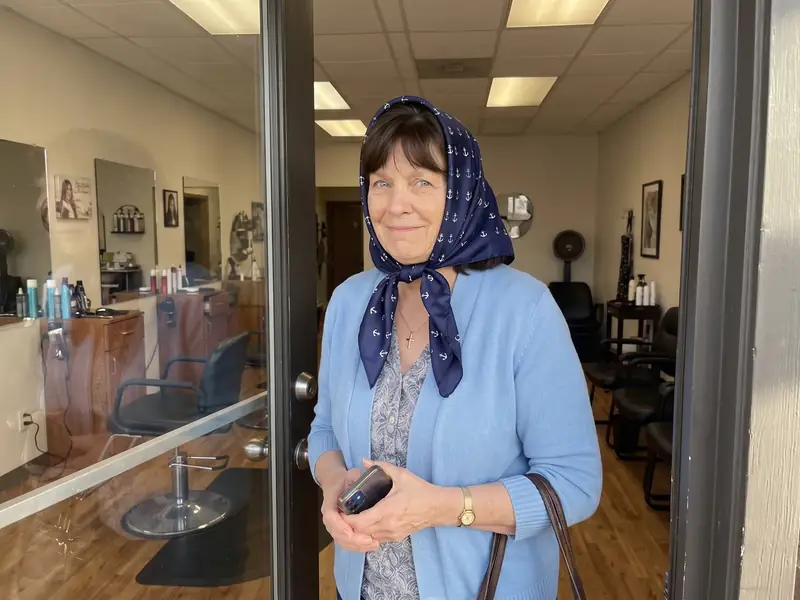
Barbara has sat in my chair every fifth Tuesday at 9:30 since 2010. She is sixty-three, a retired third-grade teacher, and she brings me lemon bars at Christmas.
Last April she came in with a silk scarf tied over her head. Navy, with little white anchors. Barbara does not wear scarves.
She sat down, did not take it off, and handed me her phone. "Look at the baptism pictures," she said.
Her grandson had been baptized the Sunday before. Beautiful pictures. And in every single one, right down the middle of Barbara's head, there was a bright white stripe, catching the church light like a chalk line.
"I was on day nineteen," she said. "I counted. I looked like I had given up, Teresa. At my own grandson's baptism."
Then she said the sentence I have not stopped hearing since: "I pay you every five weeks so I don't look like this. Why do I look like this?"
You Have Probably Done This Too
I want to stay with Barbara's question for a minute, because you have probably asked it too. Maybe not out loud.
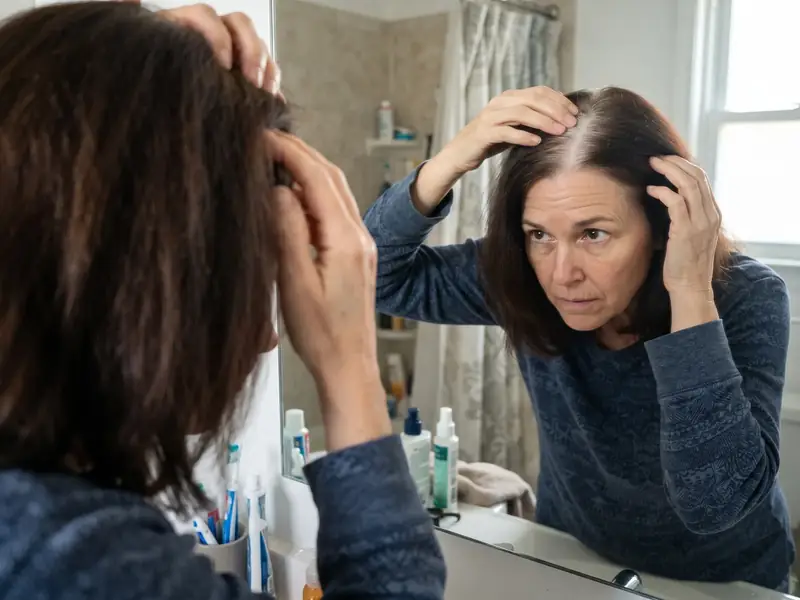
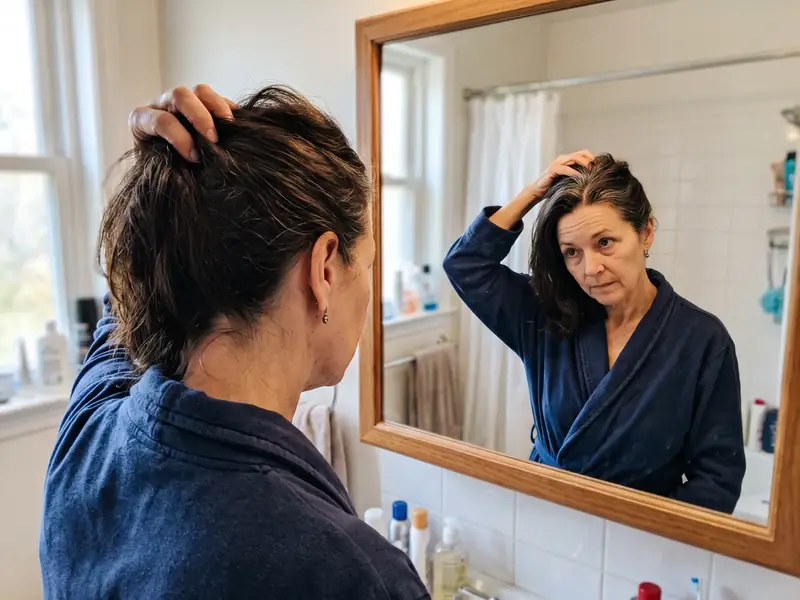
You leave the salon and for about ten days you feel like yourself. Then one morning the bathroom light hits the top of your head at a certain angle.
And there it is. A thin bright line where the part is. By the next week it is wider. By week three it is the first thing you see.
So you start the quiet little tricks. You flip the part. You wear the hair up, or down, or under a hat. You stand at the back of the group photo. You keep the camera off on the family video call.
One of my clients told me she stopped going to church on the last Sunday before every appointment. Another said her husband looked at her part and said, "Ummm, to be honest, yeah."
None of these women are vain. They just want to recognize the woman in the mirror, without counting days.
Here is what one reader wrote back to me, months after she stopped counting days. I will show you how she got there.
"I still see my stylist every six weeks for the cut. The roots are my job now. Sunday morning, coffee, fifteen minutes, done."
It Is Not Your Color Failing
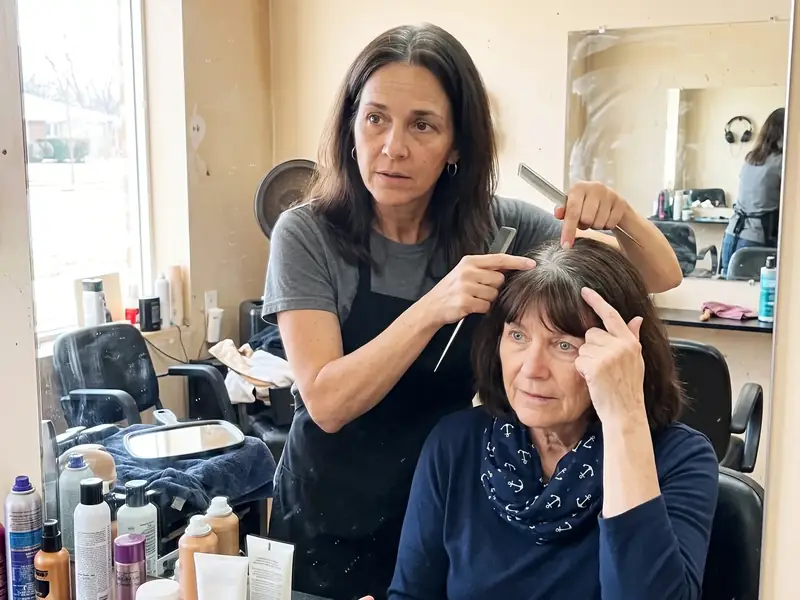
When a woman comes back with that stripe, she almost always apologizes. "I must wash it too much." "Maybe my gray is just stubborn." "Maybe I need something stronger."
I used to nod along. Some colorists even agree and sell a stronger formula. I am telling you now what I told Barbara that morning, with her scarf still on.
It is not your fault. It is not your shampoo, and it is not that your color "did not take." The color I put on Barbara was perfect. It is still perfect, on the hair it touched.
The problem is the hair it never touched. The hair that was still under her scalp the day she sat in my chair.
I Call It the Regrowth Stripe
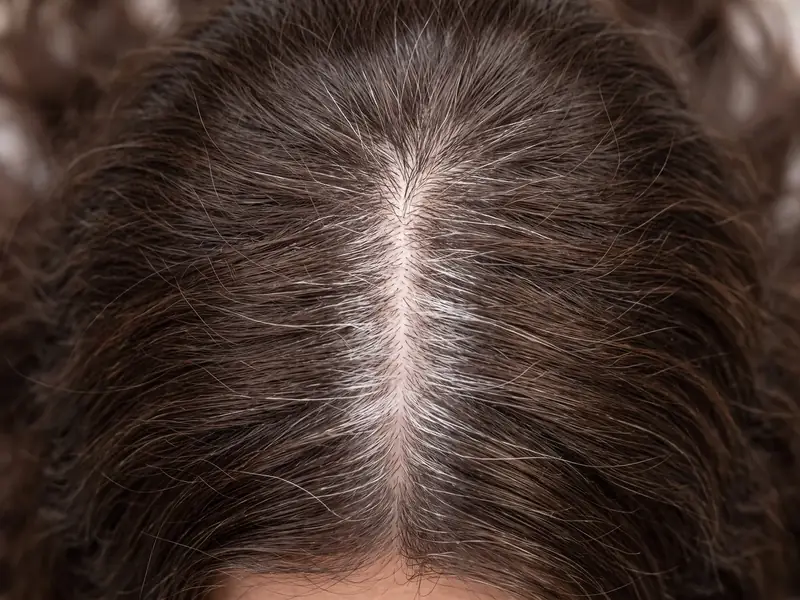
Hair grows about half an inch a month. That is a textbook number, nothing special about it.
Half an inch a month means that ten to fourteen days after a perfect color, there is already a sliver of new white hair at the scalp. On dark hair, against a straight part, that sliver shows.
By day fourteen to twenty-one it is a stripe. And the next appointment is still at week five.
I call this The Regrowth Stripe. It is the white line that comes back at your part two to three weeks after every color, while your next appointment is still weeks away.
Do the arithmetic on a five-week cycle and the hard truth is this: for roughly half of every cycle, the stripe is visible. Half the year.
So when Barbara asked why she looked like that, the honest answer was: "It's not my color failing. It's the calendar."
Stronger and Sooner Only Makes It Worse

Now, the obvious fix is to come in more often. Some women do. I have a client who has come every two and a half weeks for most of her adult life.
At $180 a visit, every two to three weeks comes to more than $3,000 a year. Just for roots. And every visit is a full-strength color on the same scalp, over and over.
The other obvious fix is a stronger, darker color so the gray takes longer to show. That does not slow your hair down. It just makes the line between dark lengths and white roots sharper when it arrives.
For reference, $180 every five weeks already comes to about $1,872 a year. I am not going to do the full math here. You know your own bank statement.
So more of the same is either more money, or a harsher line, or both. I had been offering my clients more of the same for twenty-five years.
What My Clients Do in Week Three
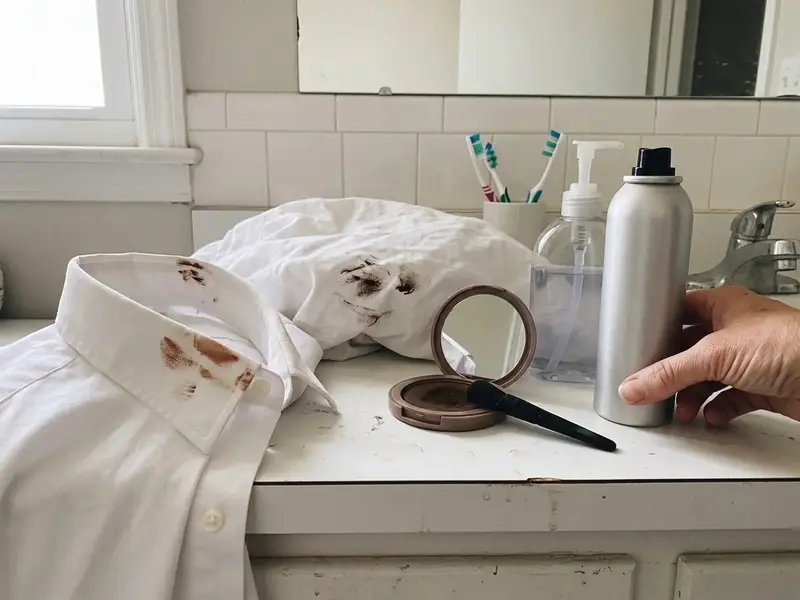
Here is something salons rarely talk about: what our clients do between visits. I see the evidence every week.
The root sprays. They work for an evening. Then I find brown smudges on a white collar, or a client tells me her pillowcase looks like a crime scene. One caught in the rain at a funeral. You can imagine.
The root powders and the little mascara wands. Fine for a dinner. Gone at the first wash, and you feel them every time you touch your head.
And then the box from the drugstore, bought in a panic the night before a wedding.
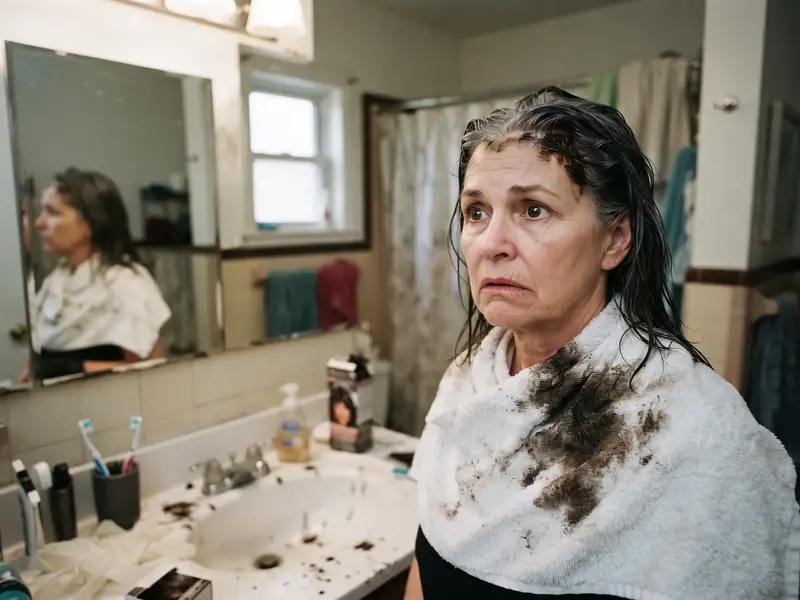
The box is my least favorite. It goes on top of the color that is already there, so the lengths get darker and darker. Clients come in with roots that turned nearly black, a hard line a few weeks later, and hair that feels like straw.
Then I spend two hours correcting it, and she pays me twice. Once for the box, once for me.
Every one of those fixes is a woman trying to close the gap the calendar opened. Not one of them closes it.
Your Fix Needs Three Things at Once
That spring, after Barbara left, I sat at my station after closing and wrote down what a real fix would need. It turned out to be three things, and all three at the same time.
One: it has to happen early. When the root first shows, around day seven to ten. Not at week five, when the stripe has already had its two weeks.
Two: it has to be gentle enough to repeat. If you are going to color something every week, it cannot be a full-strength salon color or a box that piles darker and darker.
Three: it has to be doable at home, alone, in a regular bathroom, in about the time it takes to drink a cup of coffee. No bowl, no brush, no mixing, no appointment.
Then I checked every fix against the list. The salon fails number one. It is the calendar. The box fails number two. The sprays pass number three and fail the first rain.
So the answer was not stronger color less often. It was gentler color, more often, at home. I started calling that idea Keep-Up Coverage.
Keep-Up Coverage, In Plain Words

Keep-Up Coverage is simple. Instead of one strong color every five weeks, you lay down a soft color a little at a time, at home, whenever the root starts to peek through.
The white never gets the two or three weeks it needs to become a stripe. It gets caught on day eight. Then caught again the next week.
Think of a lawn. You can let it grow knee high and hire a crew once a month, or you can run the mower every Saturday and nobody ever sees it shaggy.
Will it look exactly like my salon color on day one? No. It looks steadier. A salon color is perfect on day one and a stripe by day twenty-one. This is very good on day one and still very good on day twenty-one.
I liked the idea. I did not trust it yet. Because I have seen a lot of "color shampoos" come through the door, and most of them came in attached to an unhappy client.
I Tested It on My Hardest Heads
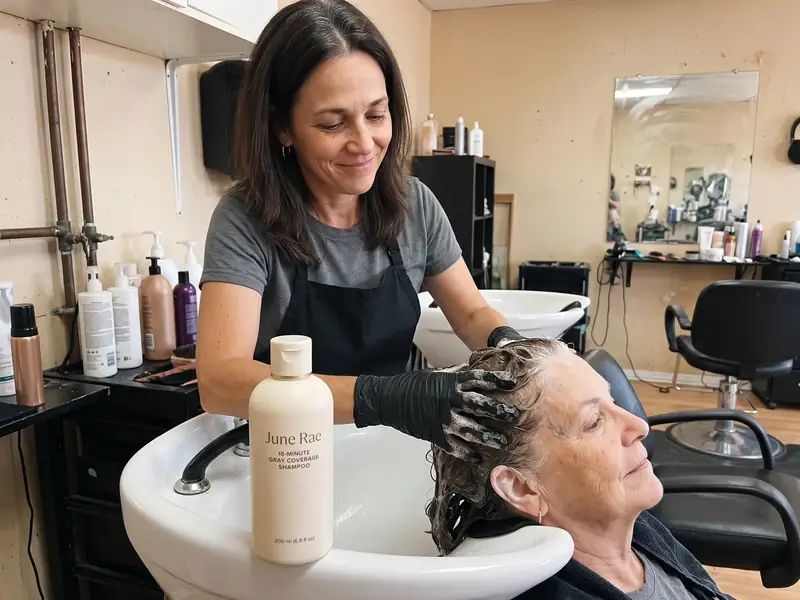
I know why the color shampoos fail, because I fix them. Women use them like a strong salon color, all at once, on their whitest temples, with the lightest shade on the shelf. Then the temples come out orange, or barely change.
So I tested one the way a colorist tests a product. On the hardest gray I have, and with my own rules.
That meant my sister-in-law's temples, which are pure white and wiry. A client with long, thick dark hair. And my own part, which I will admit has been going silver since my forties.
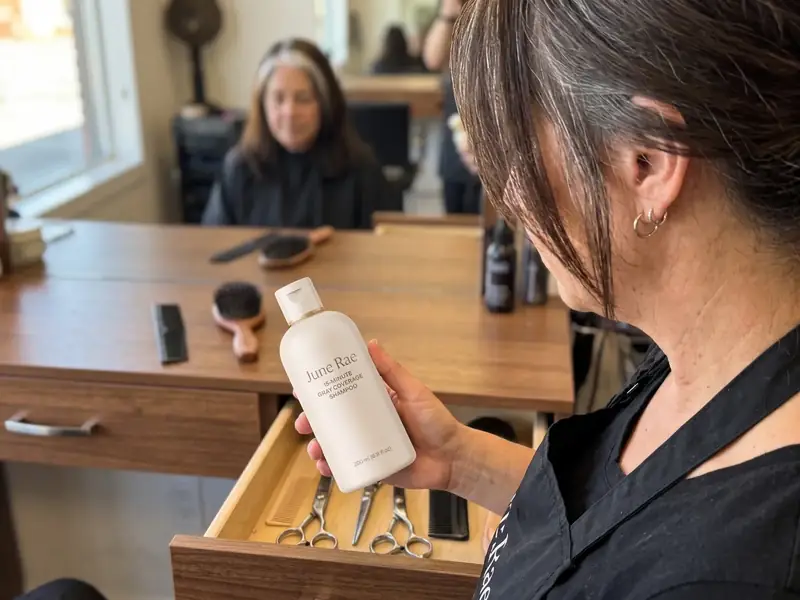
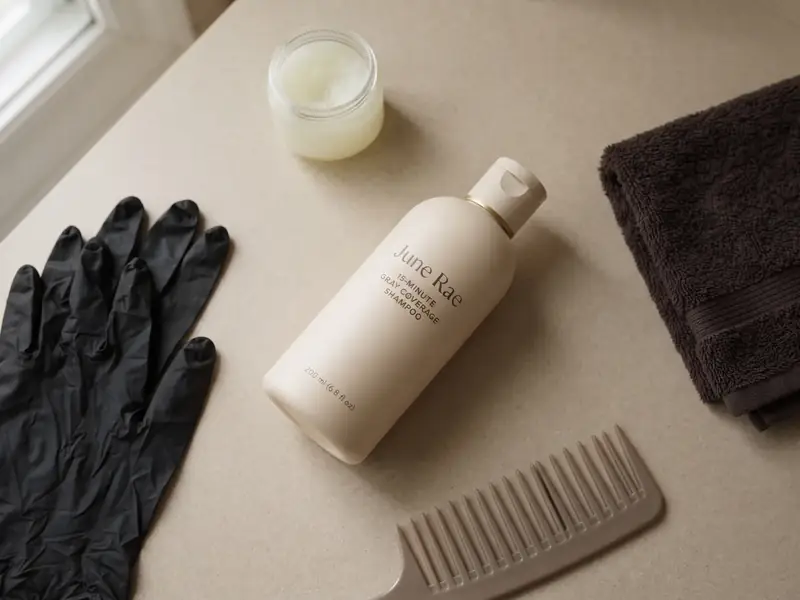
The one that held up, and the one I am writing about, is called the June Rae 15-Minute Gray Coverage Shampoo. It is a shampoo, used on dry hair, that leaves color behind. You lather it, you wait, you rinse.
I tested it for four weeks before I said a word to anyone. And I wrote down the limits, because there are some, and you should hear them from me first.
The Honest Part Nobody Prints
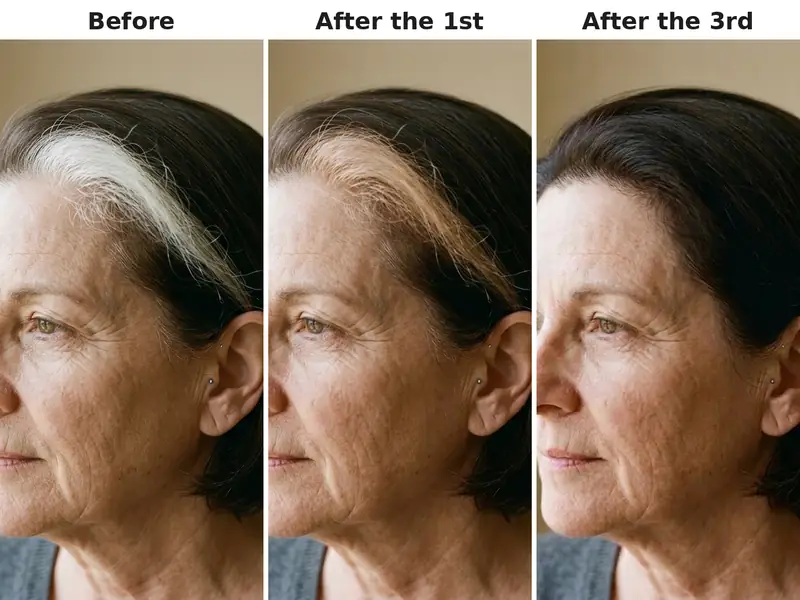
It builds. It does not blast. On my sister-in-law's white temples, the first application took the edge off. The second evened it out. By the third, I would not have known where the gray had been.
For very white temples, the first two weeks are different: two or three applications, and you can leave it on up to twenty-five minutes. After that, fifteen minutes about once a week, when the root starts to show.
Shade matters. There are three: Black, Dark Brown, Light Brown. My rule is the one I use in the salon: pick the shade your hair was before the gray came in.
And on very white temples, the first application can come out a bit warm, especially with Light Brown. The second one evens it out. Do not panic on day one.
It is real color, so it stains. Gloves, always. A little petroleum jelly along your hairline and ears. A dark towel. Wipe any color off your skin within five minutes. Anyone who tells you to skip the gloves has never cleaned a salon sink.
And do a skin test 48 hours before your first use, behind your ear or in the crease of your elbow. I do that with every new color on every client. Do not use it on an irritated or broken scalp.
One more: a 200 ml bottle gives 10 to 15 applications on short to shoulder-length hair. Fewer if your hair is long and thick. My long-haired client went through it faster, and I would rather you know that now.
"My temples are snow white. First time, not much. Second time, 25 minutes like the card says, and they matched. I wish someone had told me about the second time years ago."
The Morning I Opened the Drawer
Barbara's next Tuesday came around in May. She sat down, no scarf this time but her part flipped to the left, which tells me everything.
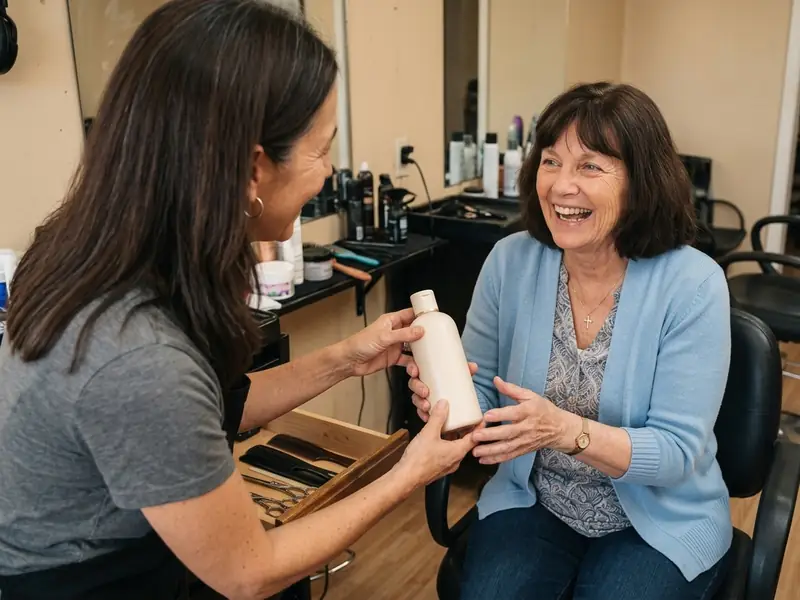
I did her color as usual. Then, before she stood up, I opened the top drawer of my station, the one where I keep my good scissors, and took out a bottle.
"Barbara," I said, "I want you to stop paying me for roots."
She laughed. Then she saw I was not joking. "You're firing me?"
"No. You still come for the cut. Every eight weeks. But on day eight after this color, you put on gloves and you use this. Fifteen minutes. Then once a week, whenever you see the root."
I showed her the three steps on her own head. I told her about the warm first time and the gloves. She looked at the bottle like it might bite her. Then she put it in her purse.
Your First Two Weeks, Step by Step
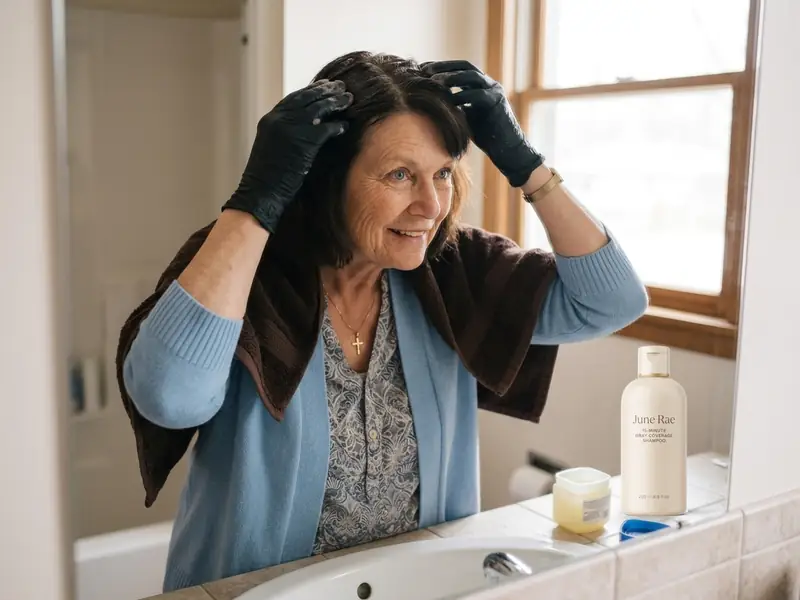
This is exactly what I wrote on the card I gave Barbara. Three steps, always in this order.
Step one. Gloves on. A little petroleum jelly on your forehead and ears. Hair dry, not wet.
Step two. Start at the temples and the part, where the gray is whitest. Work it into a lather out to the ends. Leave it fifteen minutes. Set a timer and go read something.
Step three. Rinse until the water runs clear. Dark towel. Wipe any color off your skin within five minutes.
In the first two weeks, do it two or three times, with up to twenty-five minutes on very white temples. After that, once a week or so. The color fades gently over two to four weeks, without a hard line, so there is no stripe to catch you out.
Barbara, Three Months Later

Day eight, she texted me a photo from her bathroom with the gloves still on. "Fifteen minutes. My ears are clean. Is that it?" That was it.
Day eleven, she did the second application, twenty minutes on the temples. "The left side came out a touch warm the first time. Today it matches."
Week three, the week that used to mean scarves and flipped parts. She came in for nothing at all. She said she was "just passing." She wanted me to look. There was no stripe.
Then in July she visited her sister for twelve days and forgot the bottle on her bathroom shelf. On day ten the line started to peek through at her part. She knew exactly what it was. She also knew it was not her fault.
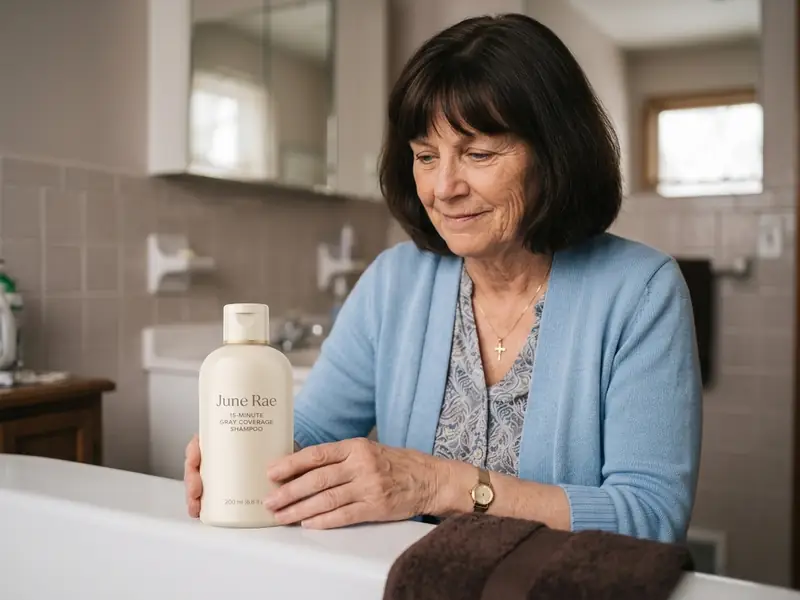
In August her grandson turned one. There is a picture of Barbara on my mirror now: front row, no scarf, hair pulled back, the baby on her hip. Her daughter took it. A cousin asked where she had her color done.
"Teresa," Barbara told her. Which is half true.
Keep Me for the Cut
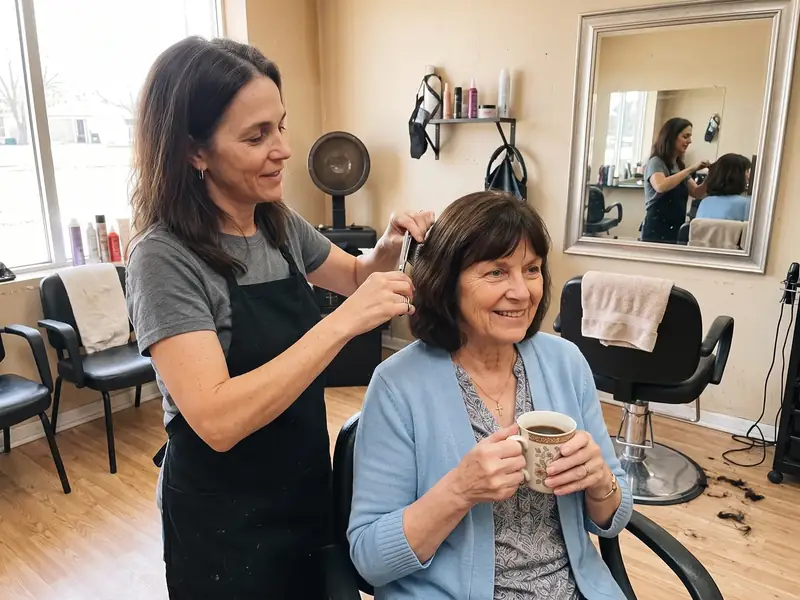
People ask me why I would tell anybody this. "You're losing money, Teresa." On the root touch-ups, yes. Some.
Here is what I am not losing. Barbara still comes every eight weeks for her cut, and she stays for coffee. She sends me her friends. She does not apologize to me anymore when she sits down.
I would rather have ten clients who are happy every week than ten clients who are happy for ten days out of thirty-five.
I know which one I would want at a baptism.
Under $5 a Wash, Not $180

Let me lay out the ladder the way I laid it out for Barbara.
Closing the stripe the salon way, every two to three weeks, is more than $3,000 a year. Leaving it at every five weeks is about $1,872 a year, and the stripe still shows half the time.
One bottle of the June Rae shampoo is $39.90. Three bottles are $79, which works out to $26.33 a bottle.
At 10 to 15 applications a bottle, that is $1.76 to $2.63 an application with the three bottles, and $2.66 to $3.99 with one. Either way, under $5 a wash.
No subscription. You are charged once. Nothing renews behind your back.
Compare that to one root appointment. Then look back at the ladder you just walked down.
Why I Tell You to Start With Three
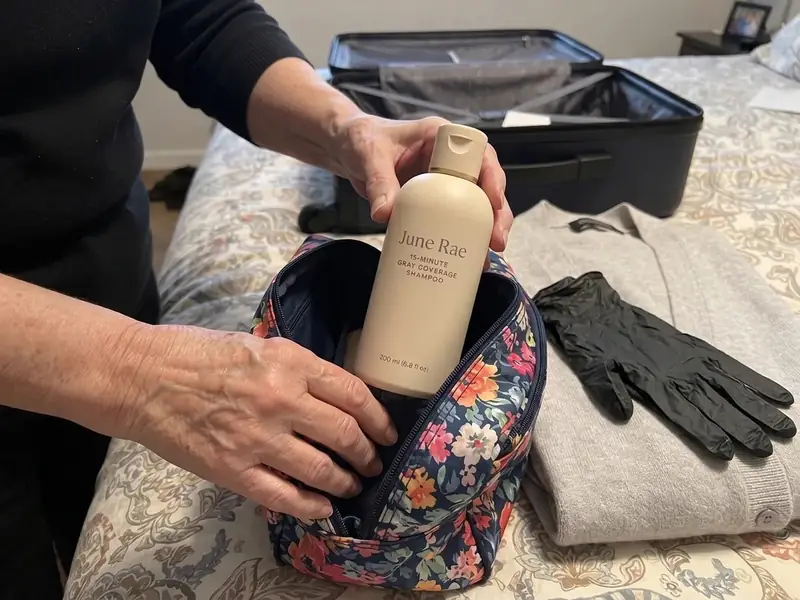
I tell my clients to start with three bottles, and here is the honest reason: Keep-Up Coverage only works if you keep it up.
The first two weeks use more, two or three applications. Then it is once a week, every week. A single bottle runs out right when the habit is starting to work.
Barbara started with the bottle from my drawer. The next month she ordered three. One lives in her travel bag now, after the twelve days at her sister's.
Whichever you choose, go by your shade: Black, Dark Brown or Light Brown, the color you were before the gray came in.
1 bottle
$39.90
$2.66 to $3.99 an application
To try it on your worst spot
3 bottles
$79
$26.33 a bottle · $1.76 to $2.63 an application
The 2-week start, then about 10 weeks at once a week
And start on day seven to ten after your last color. That is the window. If your color was last week, this week is your week.
Choose Your ShadeShips within 1-2 business days, delivered in 5 to 9 business days in the US, tracked.
Thirty Days, Even If the Bottle Is Empty

This is the part that convinced me to put my own name on this page. June Rae asked if they could print my notes. They paid for this page. They did not write the limits. I did.
You have 30 days. Use the shampoo. Use all of it if you want. Test it on your whitest temples, the hardest place you have.
If it does not do what I told you it would do, you send one email. Nothing to send back. You do not need to explain yourself or write an essay. "It didn't work for me" is enough.
And you get your money back, even if the bottle is used, even if it is empty.
That is the whole promise in six words: 30 days. Even if the bottle is used.
I have watched women get burned by "guarantees" that came with conditions: send it back at your own cost, get a partial refund, past the window. Not here.
So the only thing you are really risking is fifteen minutes in your bathroom. Your roots were going to grow back this month anyway.
Try It for 30 DaysThe Questions You Will Ask Me
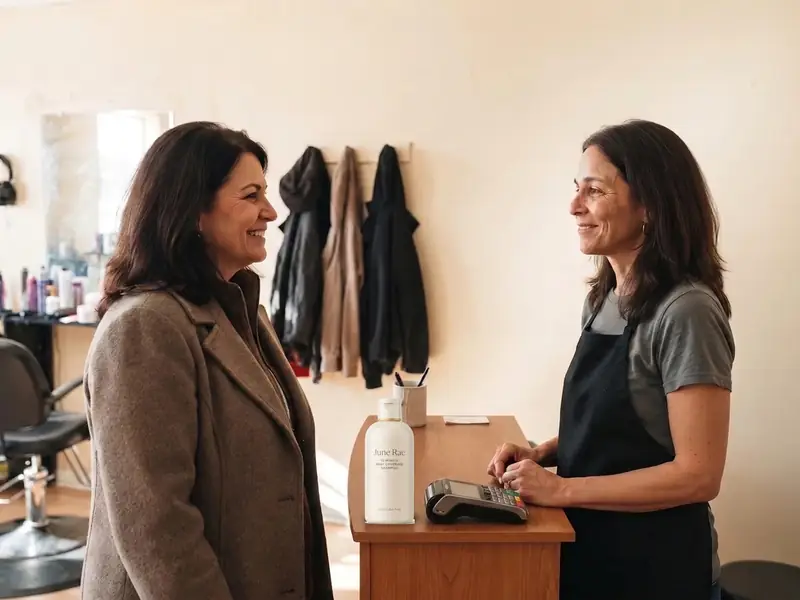
Will it really cover white, not just gray?
It builds. On very white temples, plan on two or three applications in the first two weeks, up to 25 minutes. The first one takes the edge off, the second and third even it out.
Will it turn my gray orange?
Pick the shade you were before the gray. On very white temples the first application can come out a little warm, especially with Light Brown. The second evens it out.
Will it stain my hands and my bathroom?
It is real color, so yes, if you let it. Wear gloves, use petroleum jelly on your hairline and ears, a dark towel, and wipe skin within five minutes.
I have never colored my own hair. Can I do this?
Three steps. No mixing, no bowl, no brush. If you can wash your hair, you can do this. Barbara had never colored her own hair in her life.
How long does it last?
The color fades gently over two to four weeks, without a hard line. Most women do a 15-minute application about once a week once the first two weeks are done.
What is in it, and what is not?
No ammonia and no PPD, and no two tubes to mix. It is still a color product, so do the skin test 48 hours before your first use, and skip it on an irritated or broken scalp.
How many washes are in a bottle?
10 to 15 applications on short to shoulder-length hair, fewer on long, thick hair.
How long does delivery take?
It ships within 1-2 business days and is delivered in 5 to 9 business days in the US, tracked.
What if it does not work for me?
One email within 30 days and your money comes back, even if the bottle is used or empty. Nothing to send back.
You Have Two Choices Now
Choice one is to keep doing what you are doing. Pay for the appointment. Feel like yourself for ten days. Then start flipping the part, dodging the camera, counting to week five.
That is half of every month spent hiding the top of your head from people who love you.
Choice two is fifteen minutes on a Sunday morning. Gloves, lather, a timer, a rinse. No stripe to count. You walk into the next family photo and you stand wherever you like.
If you try it and it is not for you, one email and it costs you nothing.
Choose Your ShadeWhat Women Wrote Back to Me

"I was the one who always offered to take the picture. Week three now looks like week one. I stood in the middle at my niece's wedding last month and nobody had to ask me twice."
"Works well on my part. Light Brown came out a little warm the first time and I almost quit. The second one fixed it. Wear the gloves, I learned the hard way."
"Long thick hair, so a bottle goes faster for me, which they tell you up front. Worth it to stop wearing hats in the house."
I did not write this to pull anyone out of a salon. I wrote it because a scarf with white anchors showed me what my calendar was costing the women in my chair.
Your Part, Without the Countdown
Pick your shade, put the bottle by the tub, and let week three be just another week.
Choose Your ShadeP.S. Barbara is still every eight weeks, Tuesday at 9:30. Last week she brought lemon bars in October, which she has never done. She sat down and did not flip her part. That is the whole story.
P.P.S. If you scrolled straight down here: your roots grow about half an inch a month, so the stripe shows two to three weeks after any color. A soft color at home, fifteen minutes once a week, catches it first. 30 days to try it, even if the bottle is empty.